高水準的ISO-9001-Lead-Auditor權威認證,最新的考試資料幫助妳輕松通過ISO-9001-Lead-Auditor考試
Wiki Article
BONUS!!! 免費下載KaoGuTi ISO-9001-Lead-Auditor考試題庫的完整版:https://drive.google.com/open?id=1eSpG3y6PpcGW_IY5DjnviX9B2rkOPxu2
周圍有很多朋友都通過了PECB的ISO-9001-Lead-Auditor認證考試嗎?他們都是怎麼做到的呢?就讓KaoGuTi的網站來告訴你吧。KaoGuTi的ISO-9001-Lead-Auditor考古題擁有最新最全的資料,為你提供優質的服務,是能讓你成功通過ISO-9001-Lead-Auditor認證考試的不二選擇,不要再猶豫了,快來KaoGuTi的網站瞭解更多的資訊,讓我們幫助你通過考試吧。
PECB ISO-9001-Lead-Auditor 考試大綱:
| 主題 | 簡介 |
|---|---|
| 主題 1 |
|
| 主題 2 |
|
| 主題 3 |
|
| 主題 4 |
|
| 主題 5 |
|
| 主題 6 |
|
>> ISO-9001-Lead-Auditor權威認證 <<
ISO-9001-Lead-Auditor考古題分享 - ISO-9001-Lead-Auditor資料
還在為不知道怎麼通過的ISO-9001-Lead-Auditor認證考試而煩惱嗎?現在終於不用擔心這個問題啦。KaoGuTi多年致力於ISO-9001-Lead-Auditor認證考試的研究,有著豐富的經驗,強大的考古題,幫助你高效率的通過考試。能否成功通過一項考試,並不在於你看了多少東西,而在於你是否找對了方法,KaoGuTi就是你通過ISO-9001-Lead-Auditor認證考試的正確方法!
最新的 ISO 9001 ISO-9001-Lead-Auditor 免費考試真題 (Q81-Q86):
問題 #81
Which one of the following documents addresses audit time calculation for third-party certification audits?
- A. ISO 9000
- B. ISO 17021-1
- C. ISO 9001
- D. ISO 19011
答案:B
解題說明:
ISO/IEC 17021-1 is the standard that specifies requirements for bodies providing audit and certification of management systems. It includes provisions for determining audit time for third-party certification audits, ensuring that the audits are conducted in a consistent, comparable, and reliable manner, which can be applied to a variety of management systems, including ISO 9001.
References: ISO/IEC 17021-1; IAF Mandatory Document for the Determination of Audit Time of Quality and Environmental Management Systems Certification
問題 #82
You are conducting an ISO 9001 audit of a Materials Recycling Facility. The organisation processes waste plastics into raw materials for plastic bottle manufacturers. You reach the manual picking line where operators are removing contaminant materials from incoming products, such as plastic bags, plastic film and badly contaminated items that would compromise the recycling process. You interview the line supervisor.
You: "Why are these plastic items being rejected at this stage?"
Auditee: "They do not meet our processing standards."
You: "What is the reason for that?"
Auditee: "These items are likely to damage the machinery down the line. They can also compromise our quality standards. We need to protect our reputation for good quality output materials." You: "What happens to the rejected items?" Auditee: "Some get melted down in another process later on, and some are disposed of as waste products that cannot be recycled." You: "What happens to the waste products?" Auditee: "I'm not sure. I suppose they go to landfill." After further auditing, you have gathered additional evidence. Match the following statements to the correct ISO 9001 standard clause shown.
To complete the table, click on the blank section you want to complete so that it is highlighted in red, and then click on the applicable text from the options below.
Alternatively, drag and drop each option to the appropriate blank section.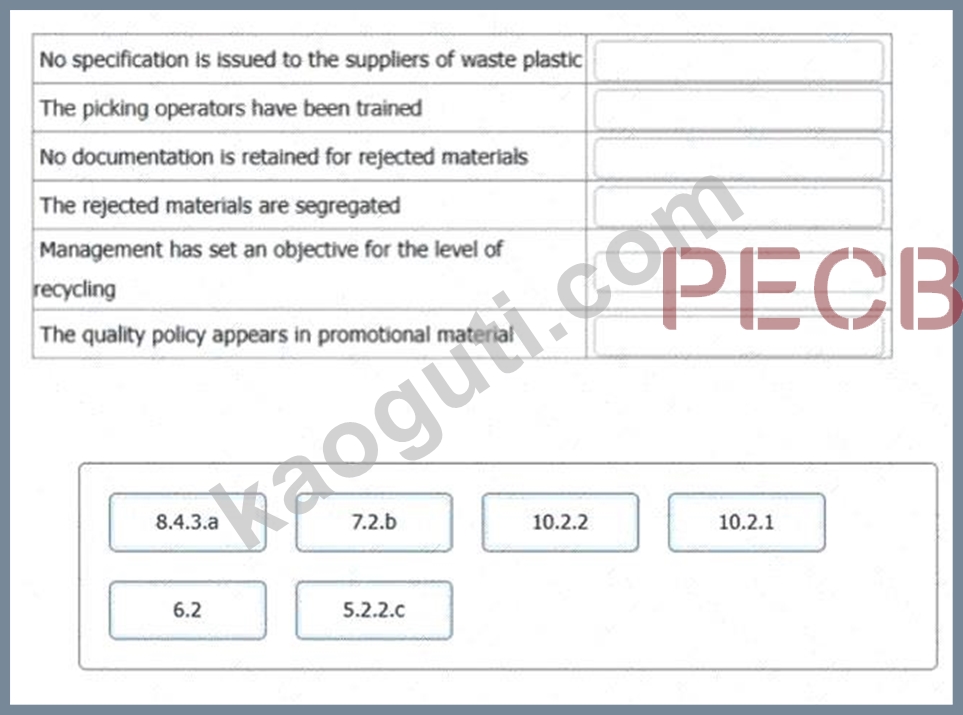
答案:
解題說明: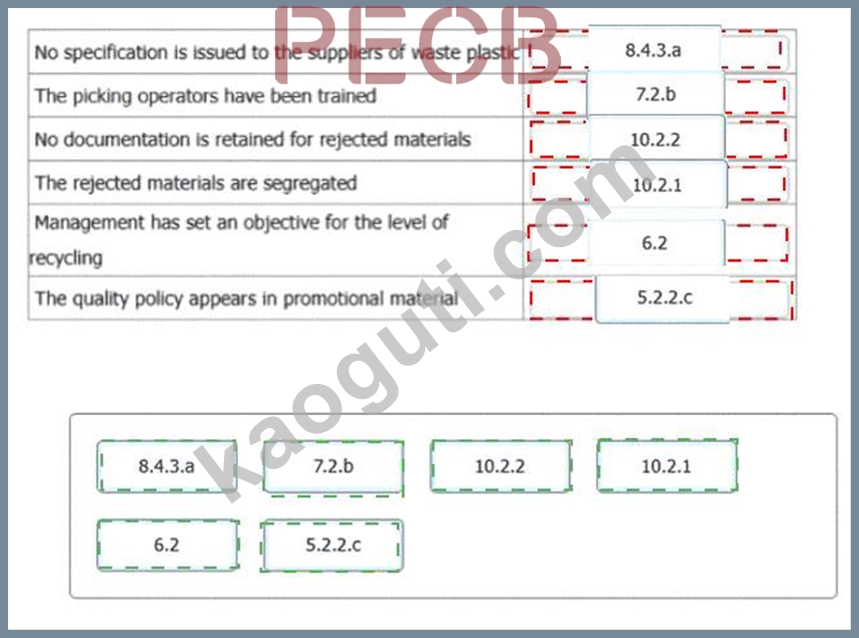
Explanation:
A # 8.4.3.a
B # 7.2.b
C # 10.2.2
D # 10.2.1
E # 6.2
F # 5.2.2.c
8.4.3.a - No specification is issued to the suppliers of waste plastic:This clause refers to the information provided to external providers, including requirements for products and services. If no specification is issued, it means the organization is not complying with this clause, which states:
"The organization shall ensure that the requirements for the products and services to be provided are adequately defined prior to communication to the external provider."
7.2.b - The picking operators have been trained:This falls under Competence requirements. Clause 7.2(b) requires that persons are competent on the basis of education, training, or experience:
"Ensure that these persons are competent on the basis of appropriate education, training, or experience."
10.2.2 - No documentation is retained for rejected materials:This relates to corrective action documentation.
Clause 10.2.2 requires organizations to retain documented information as evidence of nonconformities and actions taken:
"The organization shall retain documented information as evidence of: the nature of the nonconformities and any subsequent actions taken..."
10.2.1 - The rejected materials are segregated:This links to the treatment of nonconforming outputs. Clause
10.2.1 discusses actions such as containment or segregation for nonconforming outputs:
"Deal with nonconforming outputs in one or more of the following ways: correction; segregation, containment..."
6.2 - Management has set an objective for the level of recycling:This refers to quality objectives. Clause 6.2 requires that measurable quality objectives be established, and this includes setting performance targets:
"The organization shall establish quality objectives at relevant functions... The quality objectives shall be measurable..."
5.2.2.c - The quality policy appears in promotional material:Clause 5.2.2(c) requires the quality policy to be available to relevant interested parties. Using it in promotional material ensures that it is communicated externally:
"The quality policy shall be... available to relevant interested parties, as appropriate." References:
ISO 9001:2015, Clause 8.4.3 - Information for external providers
Clause 7.2 - Competence
Clause 10.2.2 - Corrective action documentation
Clause 10.2.1 - Nonconforming outputs
Clause 6.2 - Quality objectives
Clause 5.2.2 - Communicating the quality policy
問題 #83
A small deaning services organisation is about to start work on a hospital dleaning contract for the local Health Trust. You, as auditor, are conducting a Stage 2 audit to ISO 9001 and review the contract with the Service Manager. The contract requires that a cleaning plan is produced. You: "How was the cleaning plan for the contract developed?" Service Manager: "We have a basic template that covers the materials, labour requirements and cleaning methods to be employed. Some of that is specified by the customer." You: "How does the plan deal with locations like the intensive care wards and the operating theatres, which are included in the contract?" Service Manager: "The basic plan covers general wards, but we will do more frequent cleaning in those areas if the hospital requests it." You: "Are you aware of the regulatory requirements for cleaning standards in hospitals?" Service Manager: "No. We depend on the hospital to look after that side of things in the contract." You decide to raise a non-conformity against section 8.2.2.a.1 of ISO 9001. You decide to raise another non-conformity against section 8.2.4 of ISO 9001 when finding that the cleaning plan was amended without the agreement of the Health Trust. A different cleaning chemical was substituted to that specified in the contract. At the follow- up audit, the corrective action proposed was to "obtain a concession from the Health Trust for use of the new chemical." Which one of the following options is the reason why you did not accept this action taken?
- A. The substitute chemical has not been used before in the Health Trust.
- B. The substitute chemical may not be as effective as the original.
- C. The action assumes that the Health Trust will agree to the change.
- D. The process for making changes to the contract has not been addressed.
- E. Staff have not been trained in the use of the new chemical.
答案:D
解題說明:
Clause 8.2.4 of ISO 9001:2015 - Changes to Requirements for Products and Services:ISO 9001:2015 Clause
8.2.4 states that when changes to requirements for products or services are made, they must be communicated and agreed upon with relevant interested parties (in this case, the Health Trust). The lack of communication and agreement for substituting the cleaning chemical represents a clear violation of this clause.
Analysis of the Corrective Action Proposed:The organization proposed "obtaining a concession from the Health Trust for the use of the new chemical." This action is reactive and assumes approval from the Health Trust without addressing the systemic issue: the lack of a defined change control process for managing contract changes.
Option Analysis:
A). The substitute chemical has not been used before in the Health Trust:Incorrect. While this may be a concern, it is not directly relevant to the root cause of the nonconformity, which is the absence of a process to handle contract changes.
B). The action assumes that the Health Trust will agree to the change:Incorrect. Although this is true, it is not the primary issue. The nonconformity lies in the lack of a structured approach to obtain agreement, not whether the Health Trust agrees.
C). Staff have not been trained in the use of the new chemical:Incorrect. This is a separate issue related to staff competence (Clause 7.2), but it is not the main reason why the corrective action is unacceptable under Clause
8.2.4.
D). The process for making changes to the contract has not been addressed:Correct. The fundamental issue is the organization's failure to follow or establish a change control process for amending contracts, including gaining formal agreement from the Health Trust. The proposed corrective action does not ensure that such issues will be systematically prevented in the future.
E). The substitute chemical may not be as effective as the original:Incorrect. The effectiveness of the substitute chemical is secondary to the primary issue, which is the lack of a change management process.
ISO 9001 References Supporting the Correct Answer:
Clause 8.2.4: Requires that changes to product/service requirements be reviewed, communicated, and agreed upon with the customer.
Clause 10.2 (Nonconformity and Corrective Action): Requires the organization to address the root cause of the nonconformity and take actions to ensure it does not recur. In this case, the root cause is the absence of a change control process.
Why D is the Best Answer:The core issue is that the organization did not have a formalized process for managing and agreeing upon changes to contract requirements. Addressing this process gap is essential to prevent recurrence of similar nonconformities. Merely seeking a concession from the Health Trust is a one-off solution that does not address the systemic issue.
問題 #84
You are conducting an audit at a single-site organisation seeking certification to ISO 9001 for the first time.
The organisation manufactures cosmetics for major retailers and the name of the retailer supplied appears on the product packaging. Sales turnover has increased significantly over the past five years.
You are interviewing the new Product Development Manager. You note that a software application called SWIFT is used to help control the product development process.
You have gathered audit evidence as outlined in the table. Match the ISO 9001 clause 8.3 extracts to the audit evidence.
答案:
解題說明:
A screenshot of a computer AI-generated content may be incorrect.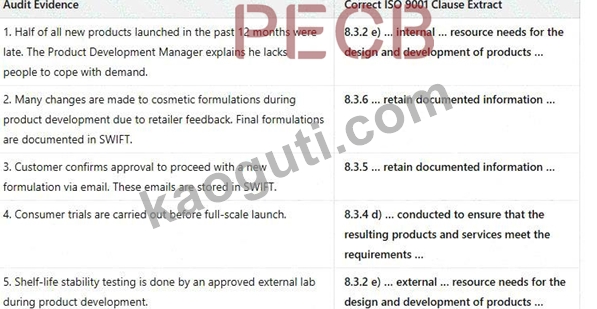
Comprehensive and Detailed In-Depth Explanation:
* Clause 8.3.2 e) - Internal Resource Needs:Delays due to staff shortages highlight a lack of internal resources, directly relating to this clause that requires internal resource planning for design and development.
* Clause 8.3.6 - Design and Development Changes:Ongoing formulation changes due to feedback need to be documented and reviewed. This clause requires retention of documented information on changes.
* Clause 8.3.5 - Design and Development Outputs:Customer approvals for formulations are outputs of the design process and must be retained as documented information, as per this clause.
* Clause 8.3.4 d) - Design and Development Controls:Consumer trials are a validation activity. This clause ensures such trials are conducted to confirm that resulting products meet defined requirements.
* Clause 8.3.2 e) - External Resource Needs:Shelf-life tests done by an external lab are part of the external resources needed for development and are referenced here.
問題 #85
You are leading a Stage 2 certification audit of a multi-site organisation and have received the audit schedule below; Head Office and Site 1 - Day 1 Site 2 (150 Km from HQ) - Days 2 and 3 During Day 1 of the audit, the dient informs you that the laboratory at Site 2 has been dosed for decontamination due to a serious outbreak of an infectious disease among workers. In Site 2, all other functions could be audited as planned.
As the audit team leader, what would you do?
Choose the best acceptable action you could take:
Ask the audit Programme Manager for direction.
Complete the audit on day 3 and report back to the certification body for a certification decision.
Continue the audit on days 2 and 3 and return later to audit the Site 2 laboratory.
Immediately cancel the audit since the audit plan cannot be completed.
Who has the responsibility for assigning work to the audit team?
- A. The audit team member
- B. The certification body
- C. The audit team leader
- D. The auditee organisation
答案:C
解題說明:
In the context of ISO 9001:2015 audits, it is the audit team leader who holds the responsibility for assigning work to the audit team. According to ISO 19011:2018 (Guidelines for auditing management systems, which complements ISO 9001:2015), the audit team leader is responsible for the organization and direction of the audit, including assigning specific roles and responsibilities to audit team members. This includes preparation of the audit plan, leading the audit, and ensuring that each team member understands their tasks.
問題 #86
......
我們KaoGuTi PECB的ISO-9001-Lead-Auditor考試的做法是最徹底的,以及最準確及時的最新的實踐檢驗,你會發現目前市場上的唯一可以有讓你第一次嘗試通過困難的信心。PECB的ISO-9001-Lead-Auditor考試認證在世界上任何一個國家將會得到承認,所有的國家將會一視同仁,KaoGuTi PECB的ISO-9001-Lead-Auditor認證證書不僅有助於提高你的知識和技能,也有助於你的職業生涯在不同的條件下多出一個可能性,我們KaoGuTi PECB的ISO-9001-Lead-Auditor考試認證合格使用。
ISO-9001-Lead-Auditor考古題分享: https://www.kaoguti.com/ISO-9001-Lead-Auditor_exam-pdf.html
- 無與倫比的ISO-9001-Lead-Auditor權威認證擁有模擬真實考試環境與場境的軟件VCE版本&最好的ISO-9001-Lead-Auditor考古題分享 ???? 打開網站▛ www.newdumpspdf.com ▟搜索「 ISO-9001-Lead-Auditor 」免費下載ISO-9001-Lead-Auditor認證考試
- 無與倫比的ISO-9001-Lead-Auditor權威認證和保證PECB ISO-9001-Lead-Auditor考試成功與高效的ISO-9001-Lead-Auditor考古題分享 ???? 到“ www.newdumpspdf.com ”搜尋▛ ISO-9001-Lead-Auditor ▟以獲取免費下載考試資料ISO-9001-Lead-Auditor考題套裝
- ISO-9001-Lead-Auditor新版題庫上線 ???? 最新ISO-9001-Lead-Auditor試題 ???? 最新ISO-9001-Lead-Auditor題庫資源 ???? 打開網站➥ tw.fast2test.com ????搜索✔ ISO-9001-Lead-Auditor ️✔️免費下載ISO-9001-Lead-Auditor證照信息
- PECB ISO-9001-Lead-Auditor權威認證和Newdumpspdf - 資格考試的領導者 ???? 透過⮆ www.newdumpspdf.com ⮄搜索⮆ ISO-9001-Lead-Auditor ⮄免費下載考試資料最新ISO-9001-Lead-Auditor考證
- 最新ISO-9001-Lead-Auditor考證 ???? ISO-9001-Lead-Auditor證照信息 ???? ISO-9001-Lead-Auditor通過考試 ???? ⇛ www.newdumpspdf.com ⇚上的➠ ISO-9001-Lead-Auditor ????免費下載只需搜尋免費下載ISO-9001-Lead-Auditor考題
- 無與倫比的ISO-9001-Lead-Auditor權威認證和保證PECB ISO-9001-Lead-Auditor考試成功與高效的ISO-9001-Lead-Auditor考古題分享 ???? 複製網址【 www.newdumpspdf.com 】打開並搜索➤ ISO-9001-Lead-Auditor ⮘免費下載ISO-9001-Lead-Auditor測試題庫
- ISO-9001-Lead-Auditor通過考試 ???? 最新ISO-9001-Lead-Auditor試題 ???? 最新ISO-9001-Lead-Auditor試題 ???? ➠ www.pdfexamdumps.com ????上的[ ISO-9001-Lead-Auditor ]免費下載只需搜尋ISO-9001-Lead-Auditor考題套裝
- ISO-9001-Lead-Auditor權威認證和資格考試中的領導者和ISO-9001-Lead-Auditor考古題分享 ???? 開啟⏩ www.newdumpspdf.com ⏪輸入【 ISO-9001-Lead-Auditor 】並獲取免費下載最新ISO-9001-Lead-Auditor考題
- 免費下載ISO-9001-Lead-Auditor考題 ☕ 最新ISO-9001-Lead-Auditor考題 ???? 最新ISO-9001-Lead-Auditor考題 ???? 立即打開➡ www.pdfexamdumps.com ️⬅️並搜索➤ ISO-9001-Lead-Auditor ⮘以獲取免費下載ISO-9001-Lead-Auditor考試大綱
- PECB ISO-9001-Lead-Auditor權威認證:QMS ISO 9001:2015 Lead Auditor Exam和資格考試的領導者 ℹ ➠ www.newdumpspdf.com ????上的▷ ISO-9001-Lead-Auditor ◁免費下載只需搜尋最新ISO-9001-Lead-Auditor考證
- 一流的ISO-9001-Lead-Auditor權威認證和資格考試的領導者和完美的ISO-9001-Lead-Auditor考古題分享 ???? 立即打開( www.pdfexamdumps.com )並搜索⏩ ISO-9001-Lead-Auditor ⏪以獲取免費下載ISO-9001-Lead-Auditor新版題庫上線
- www.stes.tyc.edu.tw, ztndz.com, www.stes.tyc.edu.tw, declanyqtq680451.atualblog.com, saadmisv432563.wikienlightenment.com, sahilwcfb308011.wikitelevisions.com, isocialfans.com, sitesrow.com, bookmarkssocial.com, nettiekftt614552.wikijm.com, Disposable vapes
P.S. KaoGuTi在Google Drive上分享了免費的、最新的ISO-9001-Lead-Auditor考試題庫:https://drive.google.com/open?id=1eSpG3y6PpcGW_IY5DjnviX9B2rkOPxu2
Report this wiki page